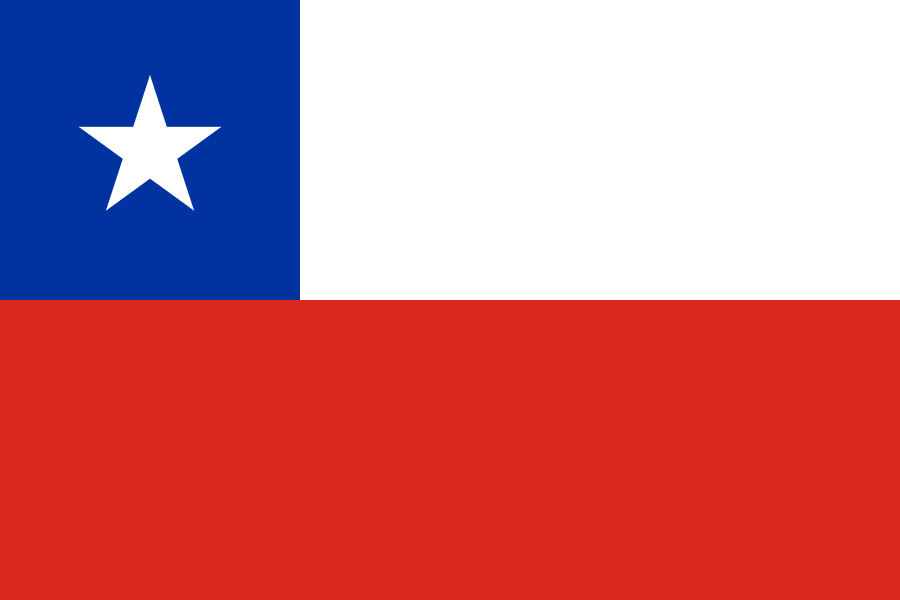
Chile
History
Chile, officially the Republic of Chile, is a country in western South America. It is the southernmost country in the world and the closest to Antarctica, extending along a narrow strip of land between the Andes Mountains and the Pacific Ocean. According to the 2024 census, Chile had an enumerated population of 18.5 million. The country covers a territorial area of 756,102 square kilometers (291,933 sq mi), sharing borders with Peru to the north, Bolivia to the northeast, Argentina to the east, and the Drake Passage to the south. It also administers several Pacific islands, including Juan Fernández, Isla Salas y Gómez, Desventuradas, and Easter Island, and claims about 1,250,000 square kilometers (480,000 sq mi) of Antarctica as the Chilean Antarctic Territory. The capital and largest city is Santiago, and the official and national language is Spanish. Spain conquered and colonized the region in the mid-16th century, replacing Inca rule; however, they failed to conquer the autonomous tribal Mapuche people who inhabited what is now south-central Chile. Chile emerged as a relatively stable authoritarian republic in the 1830s after its 1818 declaration of independence from Spain. During... Summary adapted from the English Wikipedia (CC BY-SA 4.0). The live article includes citations, maps, and updates.