🏴 MostFlags
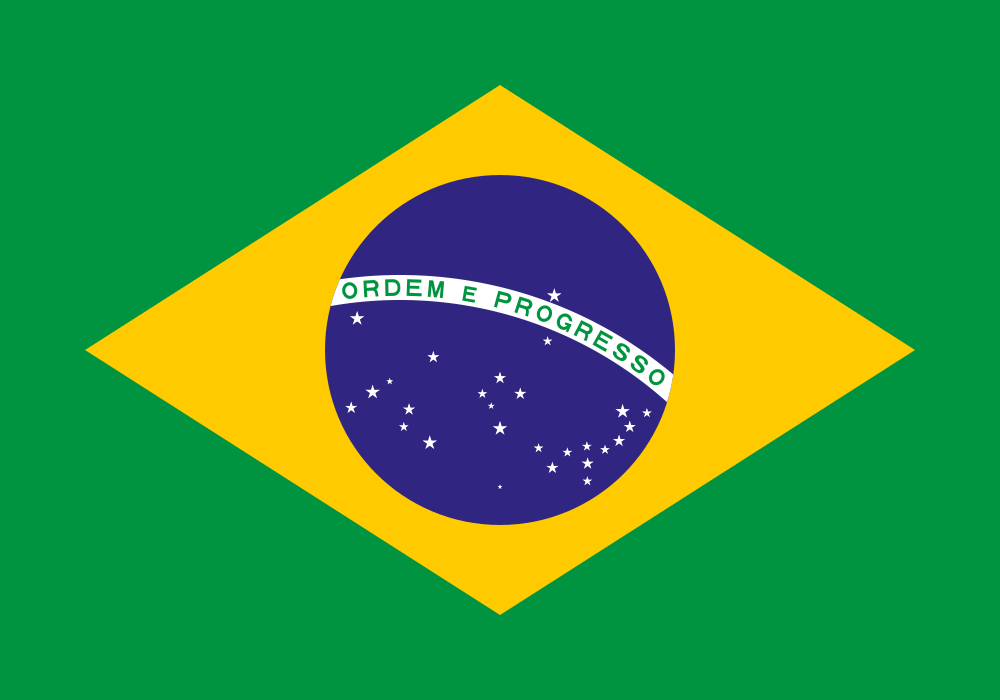
Flag of Brazil

In use: 1889 – present

Brazil

History

Brazil, officially the Federative Republic of Brazil, is the largest country in South America. It is also the world's fifth-largest country by area and the seventh-largest by population, with over 213 million people. The country is a federation composed of 26 states and a Federal District, which hosts the capital, BrasĂ­lia. Its most populous city is SĂŁo Paulo, followed by Rio de Janeiro. Brazil has the most Portuguese speakers in the world and is the only country in the Americas where Portuguese is an official language. Bounded by the Atlantic Ocean on the east, Brazil has a coastline of 7,491 kilometers (4,655 mi). Covering roughly half of South America's land area, it borders all other countries and territories on the continent except Ecuador and Chile. Brazil encompasses a wide range of tropical and subtropical landscapes, as well as wetlands, savannas, plateaus, and low mountains. It contains most of the Amazon basin, including the world's largest river system and most extensive virgin tropical forest. Brazil has diverse wildlife, a variety of ecological systems, and extensive natural resources spanning numerous protected habitats. The country ranks first among 17 megadiverse countries... Summary adapted from the English Wikipedia (CC BY-SA 4.0). The live article includes citations, maps, and updates.

Colors

Green, Yellow, Blue, White

Green represents the forests of Brazil; yellow the gold mineral wealth; blue the sky over Rio de Janeiro; white the stars and the words of the national motto.

Symbols

Green field, yellow diamond, blue disc with stars and the motto 'Ordem e Progresso'

The stars depict the night sky over Rio de Janeiro on November 15, 1889 — the date of the proclamation of the Republic.

Brazil | MostFlags