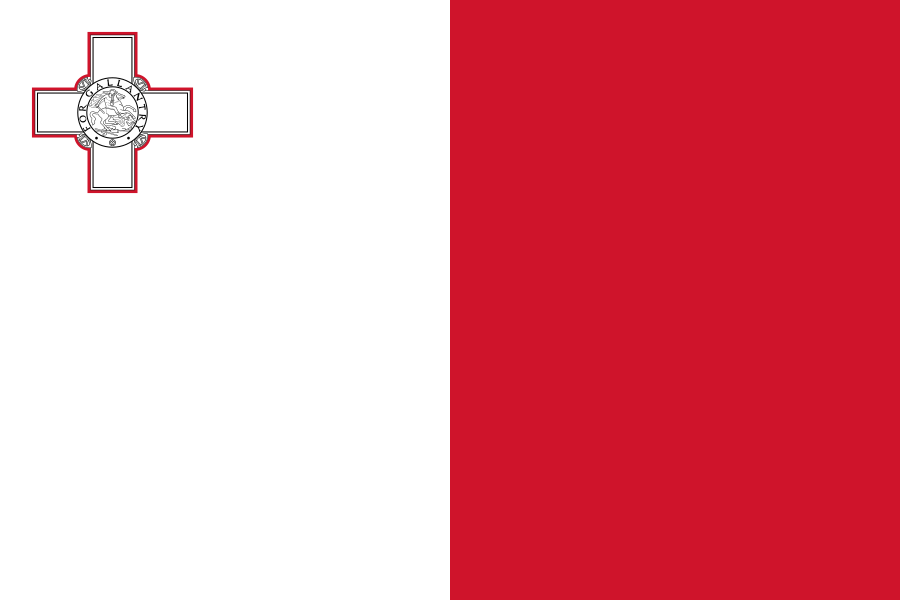
Malta
History
Malta, officially the Republic of Malta, is an island country in Southern Europe located in the Mediterranean Sea, between Sicily and North Africa. It consists of an archipelago 80 km (50 mi) south of Italy, 284 km (176 mi) east of Tunisia, and 333 km (207 mi) north of Libya. The two official languages are Maltese and English but Maltese is recognised as the national language. The country's capital is Valletta, which is the smallest capital city in the European Union (EU) by both area and population. With a population of about 574,250 spread over an area of 316 km2 (122 sq mi), Malta is the world's tenth-smallest country by area and the ninth-most densely populated. Various sources consider the country to consist of a single urban region, for which reason it is often described as a city-state. Malta has been inhabited since at least 6500 BC, during the Mesolithic. Its location in the centre of the Mediterranean has historically given it great geostrategic importance, with a succession of powers having ruled the islands and shaped its culture and society. These include the Phoenicians, Carthaginians, Greeks, and Romans in antiquity; the Arabs, Normans, and Aragonese during the Middle... Summary adapted from the English Wikipedia (CC BY-SA 4.0). The live article includes citations, maps, and updates.