In use: 2014 – present
Nonbinary Pride Flag
History
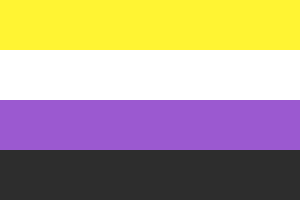
The Nonbinary Pride Flag was created by Kye Rowan in February 2014 in response to a call from the nonbinary community for a flag that spoke directly to nonbinary people rather than being a subset of the transgender flag or the genderqueer flag. The genderqueer flag had been created in 2011 by Marilyn Roxie, using lavender, white, and green stripes to represent androgyny, agender identity, and third-gender identity. Some nonbinary people felt well-represented by the genderqueer flag; others did not, particularly those whose nonbinary experience was less connected to gender fluidity and more to a complete rejection of the gender binary. Rowan's response was a four-stripe flag with distinct meanings: yellow (representing gender outside the binary entirely, since yellow is often used as a colour outside the blue/pink binary); white (representing all genders, as white contains all colours of light); purple (representing mixed genders or genders that are combinations of male and female, since purple mixes blue and pink); and black (representing agender identity, an absence of gender, as black is an absence of colour). The flag was announced on Tumblr and spread quickly through nonbinary communities online. It has become the most widely used nonbinary flag, though many alternatives exist — a reflection of the diversity of nonbinary experience itself. The flag's design deliberately avoids pink and blue, the colours most associated with the gender binary it rejects.
Colors
Yellow, White, Purple, Black
Yellow represents gender outside the binary; white represents all genders; purple represents mixed genders; black represents agender identity.
Symbols
Four horizontal stripes — yellow, white, purple, black