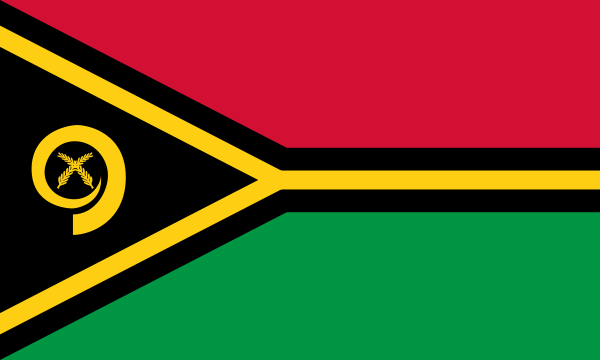
Vanuatu
History
Vanuatu (English: VAH-noo-AH-too or van-WAH-too; Bislama and French pronunciation [vanuatu]), officially the Republic of Vanuatu (French: RĂ©publique de Vanuatu; Bislama: Ripablik blong Vanuatu), is an island country in Melanesia located in the South Pacific Ocean. The archipelago, which is of volcanic origin, is 1,750 km (1,090 mi) east of northern Australia, 540 km (340 mi) northeast of New Caledonia, east of New Guinea, southeast of Solomon Islands, and west of Fiji. Vanuatu was first inhabited by Melanesian people. The first Europeans to visit the islands were a Spanish expedition led by Portuguese navigator Fernandes de QueirĂłs, who arrived on the largest island, EspĂritu Santo, in 1606. QueirĂłs claimed the archipelago for Spain, as part of the colonial Spanish East Indies and named it La Austrialia del EspĂritu Santo. In the 1880s, France and the United Kingdom claimed parts of the archipelago, and in 1906, they agreed on a framework for jointly managing the archipelago as the New Hebrides through an Anglo-French condominium. In the 1970s, an independence movement arose, and the Republic of Vanuatu was founded in 1980. Since its independence, the country has become a member... Summary adapted from the English Wikipedia (CC BY-SA 4.0). The live article includes citations, maps, and updates.