Togo
History
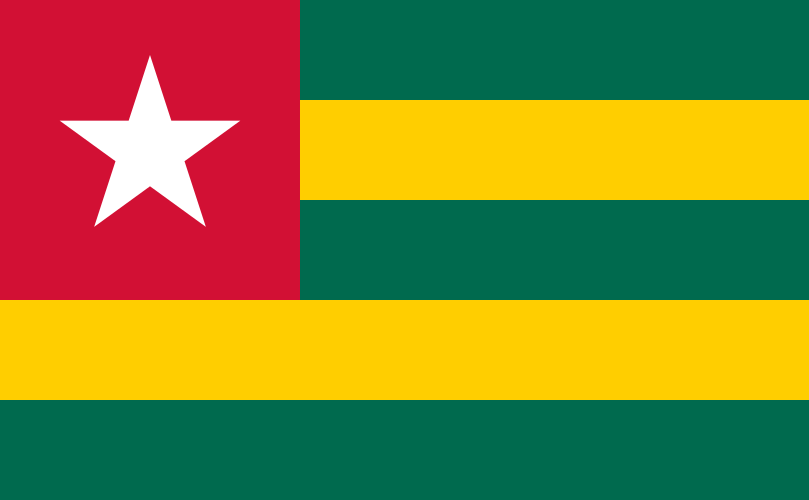
Togo, officially the Togolese Republic, is a country in West Africa. It is bordered by Ghana to the west, Benin to the east and Burkina Faso to the north. It is one of the least developed countries in the world. It extends north from the Gulf of Guinea (where its capital, Lomé, is located) to the Burkina Faso-Togo border. It is a small, tropical country, spanning 57,000 square kilometres (22,000 square miles) with a population of approximately 8 million, and it has a width of less than 115 km (71 mi) between Ghana and its eastern neighbor Benin. Various peoples settled the boundaries of present-day Togo between the 11th and 16th centuries. Between the 16th and 18th centuries, the coastal region served primarily as a European slave trading outpost, earning Togo and the surrounding region the name "The Slave Coast". In 1884, during the scramble for Africa, Germany established a protectorate in the region called Togoland. After World War I, Togo was transferred to France with its contemporary borders. Togo gained independence from France in 1960. In 1967, Gnassingbé Eyadéma led a successful military coup d'état and became president of an anti-communist, single-party state. In 1993, Eyadéma... Summary adapted from the English Wikipedia (CC BY-SA 4.0). The live article includes citations, maps, and updates.